Blab News
G7 Summit Begins in Evian Amid Massive Geneva Protest and Heightened Security
On Monday, the Group of Seven (G7) convened in the French lakeside resort of Évian‑les‑Bains, while a sprawling demonstration in Geneva drew the attention of Swiss authorities and the global community.
The three‑day summit, scheduled for 15‑17 June, is chaired by France, which holds the rotating 2026 presidency. Its agenda foregrounds the Russia‑Ukraine war, Middle East tensions, sustainable economic growth, and the future of artificial intelligence. French President Emmanuel Macron announced on social media that France would work with allies to facilitate a ceasefire between Ukraine and Russia.
U.S. President Donald Trump is slated to arrive later that afternoon, joining heads of state from the United Kingdom, Germany, Italy, Canada, and Japan.
The launch of the summit coincided with a protest organized by the coalition “No G7.” Police sources cited by Le Monde reported that roughly 20,000 demonstrators gathered near the United Nations headquarters on Sunday evening. Clashes with police erupted, and several shops in Geneva’s old town boarded up their storefronts with wooden panels to guard against looting or vandalism.
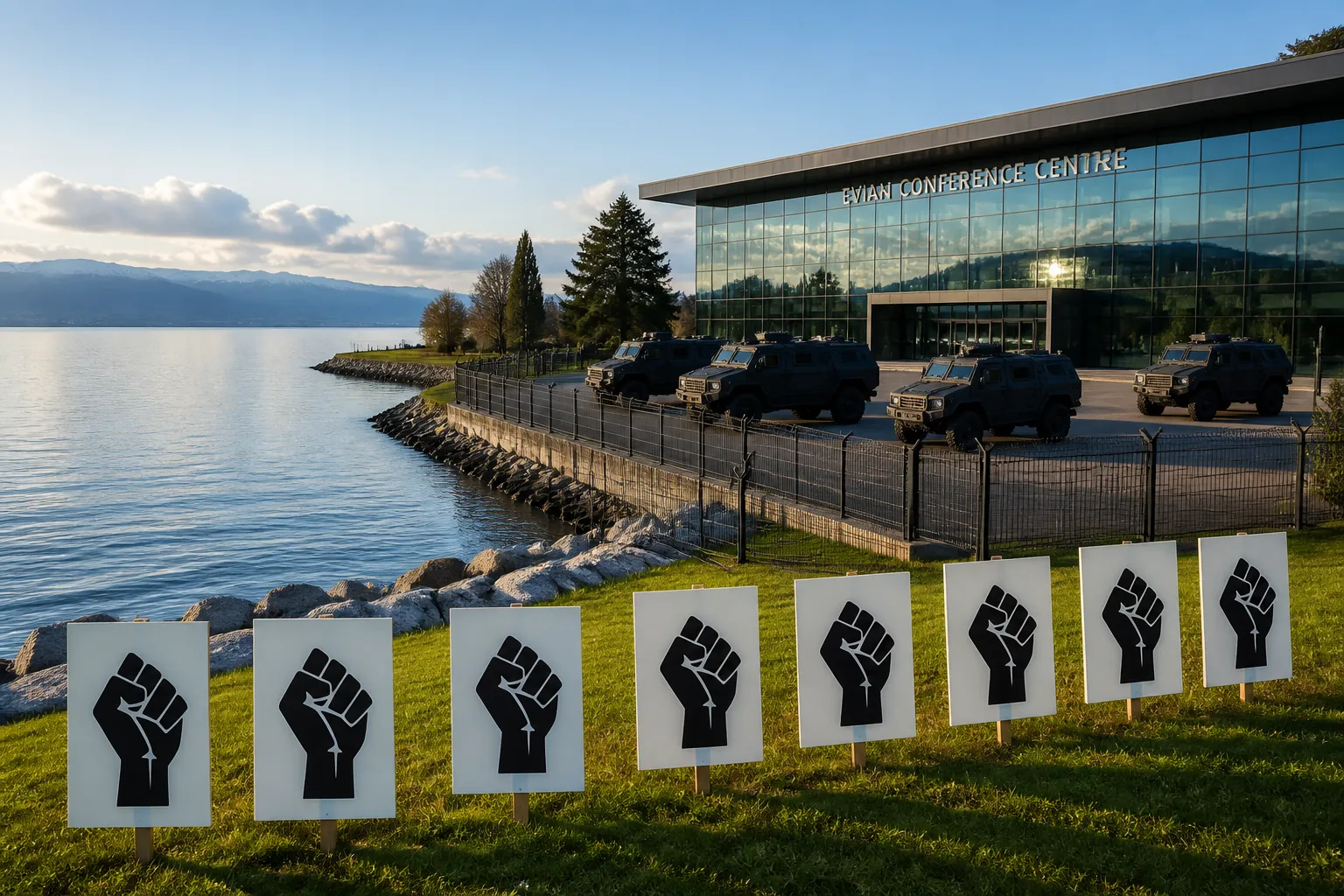
Swiss authorities have heightened security in the run‑up to the event. The canton of Geneva deployed about 4,000 military personnel and closed most of its 35 border crossings with France. France mobilised roughly 16,000 police and gendarmerie officers. The Swiss Federal Council approved temporary border checks from 10 to 19 June, a measure requested by Geneva officials to mitigate security risks.
Le Temps, a Swiss daily, criticised the summit, arguing that the G7 no longer reflects the current global geopolitical landscape and that the event is “ruining the lives of local residents.” The editorial reflects growing frustration in some European circles over the perceived exclusivity of the forum.
Évian‑les‑Bains previously hosted the 2003 G8 summit, which was marred by riots in Geneva. The 2026 meeting marks the first time the town has hosted a G7 or G8 leaders’ summit twice.
The G7, comprising the United States, United Kingdom, France, Germany, Italy, Canada, and Japan, is an intergovernmental forum that meets annually to coordinate policy on security, economics, and technology. The group has no legal charter but wields significant influence through the collective weight of its members.
The agenda’s focus on the Russia‑Ukraine conflict comes at a time when the war remains ongoing, with Russian forces occupying roughly 20 % of Ukraine and the conflict generating a large refugee crisis. The Middle East tensions refer to ongoing instability in the region, while the economic and AI topics reflect the G7’s interest in maintaining global economic stability and guiding the development of emerging technologies.
Security measures in Geneva and the surrounding region are expected to remain in place through the end of the summit. Swiss officials warn that traffic, public transport, and other services may experience disruptions due to the large‑scale demonstrations and road closures.
Observers will watch closely as the G7 leaders issue statements on the Ukraine ceasefire, provide guidance on economic policy, and discuss the future of AI regulation. The presence of Donald Trump, who has not yet served as U.S. president, adds an extra layer of interest to the proceedings.
As the summit proceeds, Swiss and French security forces will continue to monitor the situation in Geneva and the border region. The G7 leaders will meet in Évian to discuss the agenda items, while the protest movement in Geneva remains active. The international community will be watching for any developments that could influence the trajectory of the Russia‑Ukraine war, Middle East stability, and global economic policy.
The G7 summit is scheduled to conclude on 17 June, after which the leaders will return to their respective countries. Final statements and any agreements reached will be announced in the coming days, with potential implications for international diplomacy, security policy, and economic regulation.
The three‑day summit, scheduled for 15‑17 June, is chaired by France, which holds the rotating 2026 presidency. Its agenda foregrounds the Russia‑Ukraine war, Middle East tensions, sustainable economic growth, and the future of artificial intelligence. French President Emmanuel Macron announced on social media that France would work with allies to facilitate a ceasefire between Ukraine and Russia.
U.S. President Donald Trump is slated to arrive later that afternoon, joining heads of state from the United Kingdom, Germany, Italy, Canada, and Japan.
The launch of the summit coincided with a protest organized by the coalition “No G7.” Police sources cited by Le Monde reported that roughly 20,000 demonstrators gathered near the United Nations headquarters on Sunday evening. Clashes with police erupted, and several shops in Geneva’s old town boarded up their storefronts with wooden panels to guard against looting or vandalism.
Swiss authorities have heightened security in the run‑up to the event. The canton of Geneva deployed about 4,000 military personnel and closed most of its 35 border crossings with France. France mobilised roughly 16,000 police and gendarmerie officers. The Swiss Federal Council approved temporary border checks from 10 to 19 June, a measure requested by Geneva officials to mitigate security risks.
Le Temps, a Swiss daily, criticised the summit, arguing that the G7 no longer reflects the current global geopolitical landscape and that the event is “ruining the lives of local residents.” The editorial reflects growing frustration in some European circles over the perceived exclusivity of the forum.
Évian‑les‑Bains previously hosted the 2003 G8 summit, which was marred by riots in Geneva. The 2026 meeting marks the first time the town has hosted a G7 or G8 leaders’ summit twice.
The G7, comprising the United States, United Kingdom, France, Germany, Italy, Canada, and Japan, is an intergovernmental forum that meets annually to coordinate policy on security, economics, and technology. The group has no legal charter but wields significant influence through the collective weight of its members.
The agenda’s focus on the Russia‑Ukraine conflict comes at a time when the war remains ongoing, with Russian forces occupying roughly 20 % of Ukraine and the conflict generating a large refugee crisis. The Middle East tensions refer to ongoing instability in the region, while the economic and AI topics reflect the G7’s interest in maintaining global economic stability and guiding the development of emerging technologies.
Security measures in Geneva and the surrounding region are expected to remain in place through the end of the summit. Swiss officials warn that traffic, public transport, and other services may experience disruptions due to the large‑scale demonstrations and road closures.
Observers will watch closely as the G7 leaders issue statements on the Ukraine ceasefire, provide guidance on economic policy, and discuss the future of AI regulation. The presence of Donald Trump, who has not yet served as U.S. president, adds an extra layer of interest to the proceedings.
As the summit proceeds, Swiss and French security forces will continue to monitor the situation in Geneva and the border region. The G7 leaders will meet in Évian to discuss the agenda items, while the protest movement in Geneva remains active. The international community will be watching for any developments that could influence the trajectory of the Russia‑Ukraine war, Middle East stability, and global economic policy.
The G7 summit is scheduled to conclude on 17 June, after which the leaders will return to their respective countries. Final statements and any agreements reached will be announced in the coming days, with potential implications for international diplomacy, security policy, and economic regulation.