Blab News
Missouri Voters Set to Decide Whether Lawmakers Can Expand Sales Taxes to Replace State Income Tax
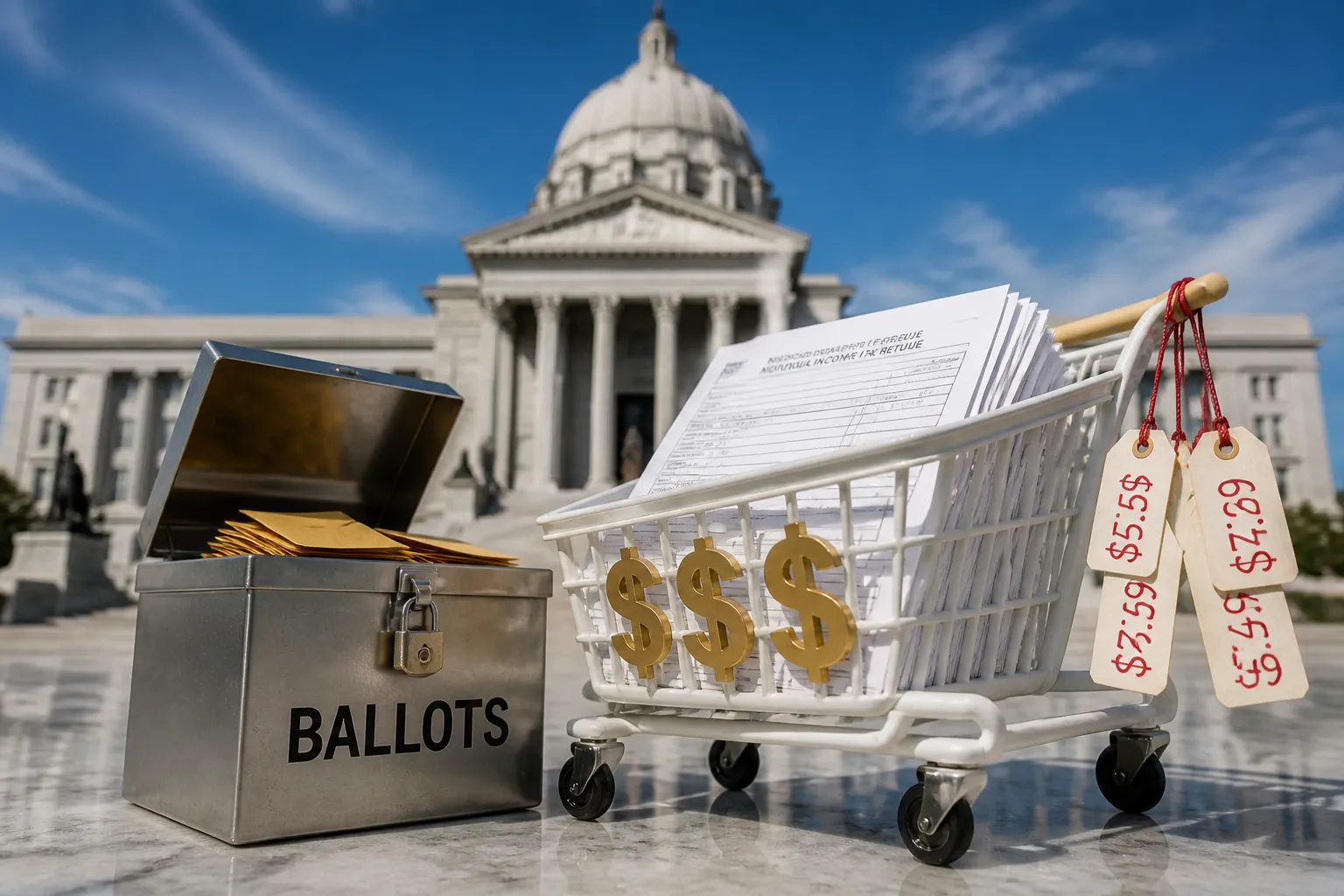
On Tuesday, Missouri residents will head to the polls to decide whether the state’s constitution can be amended to give lawmakers the power to expand sales and use taxes in place of the state income tax. The measure, known as Amendment 5, would grant the General Assembly authority to raise or broaden transaction‑based taxes for up to five years to make up the revenue lost when the income tax is phased out.
Gov. Mike Kehoe first floated the idea in his January State of the State address, claiming the plan would "create new revenue for local governments" by taxing services that are currently untaxed, such as online advertising and e‑books. Supporters say eliminating the income tax would spur economic growth and attract new residents. State Rep. Bishop Davidson, a sponsor of the amendment, said the proposal would give the legislature a "clear path" to replace the $8.5 billion in annual income‑tax revenue that now accounts for more than half of the state’s general revenue.
Opponents argue the amendment would raise the cost of living for most Missourians. Amy Blouin, president and CEO of the Missouri Budget Project, warned that the plan would require a 16 % combined state‑and‑local sales‑tax rate or an expansion of the sales tax to almost all goods and services. "The more things that are exempt, the higher the rate has to go in order to generate the same amount of revenue," Blouin said. She added that the shift would be regressive, disproportionately affecting low‑ and middle‑income residents.
Town halls across the state have reflected the debate. In Washington, Missouri, Davidson and Sen. Ben Brown answered questions from a crowd of about 50 people. One attendee, Behla Ascher of St. Clair, said she was still unsure how to vote after learning about the amendment’s potential effects. "I’ve heard some really good information from both sides, and I’m still trying to understand the total, like all aspects of it," she said. Steve Nieder of Washington, a supporter, said he favored the amendment for future generations, noting that he would prefer not to pay income tax on his own earnings.
The Catholic bishops of the St. Louis, Kansas City, Jefferson City and Springfield‑Cape Girardeau dioceses issued a statement saying that expanding sales and use taxes "should be weighed alongside the potential effects on those who are most vulnerable." The bishops cautioned that a tax system that relies heavily on regressive forms of taxation could place a disproportionate burden on lower‑income residents.
Retirees and seniors have also voiced concerns. Cheri Stephens, who noted that a 2023 law exempts Social Security benefits from state income tax, said she would not benefit from the amendment. "I’m not taxed on those, and so a vote yes for me would honestly be just I vote yes to have sales taxes increased because it’s not benefiting me in any other way," she said. AARP Missouri’s Jay Hardenbrook said the proposal would be a "bad deal for retirees," arguing that the amendment would raise taxes on goods and services that seniors rely on.
The amendment’s language includes guardrails. According to the Missouri Budget Project, the amendment would give lawmakers a five‑year window to expand transaction‑based taxes and would require that any changes to sales and use taxes be pursued in pursuit of lowering the income tax. Davidson said the amendment would also require local entities that collect more revenue from an expanded tax base to reduce other taxes, such as local sales taxes or property taxes. Blouin, however, doubted that localities would cut property taxes, predicting that they would instead lower sales taxes.
Kehoe has stated that he would never support extending sales taxes on agriculture, health care or real estate. Hardenbrook asked whether health care, long‑term care, in‑home care and over‑the‑counter medications would be included. No exemptions are listed in the amendment; lawmakers would determine which items are exempt.
Missouri voters will ultimately decide whether to trust lawmakers to shape the state’s tax policy. The outcome will determine whether the state can eliminate its income tax and how it will balance the need for revenue with the impact on residents.
Gov. Mike Kehoe first floated the idea in his January State of the State address, claiming the plan would "create new revenue for local governments" by taxing services that are currently untaxed, such as online advertising and e‑books. Supporters say eliminating the income tax would spur economic growth and attract new residents. State Rep. Bishop Davidson, a sponsor of the amendment, said the proposal would give the legislature a "clear path" to replace the $8.5 billion in annual income‑tax revenue that now accounts for more than half of the state’s general revenue.
Opponents argue the amendment would raise the cost of living for most Missourians. Amy Blouin, president and CEO of the Missouri Budget Project, warned that the plan would require a 16 % combined state‑and‑local sales‑tax rate or an expansion of the sales tax to almost all goods and services. "The more things that are exempt, the higher the rate has to go in order to generate the same amount of revenue," Blouin said. She added that the shift would be regressive, disproportionately affecting low‑ and middle‑income residents.
Town halls across the state have reflected the debate. In Washington, Missouri, Davidson and Sen. Ben Brown answered questions from a crowd of about 50 people. One attendee, Behla Ascher of St. Clair, said she was still unsure how to vote after learning about the amendment’s potential effects. "I’ve heard some really good information from both sides, and I’m still trying to understand the total, like all aspects of it," she said. Steve Nieder of Washington, a supporter, said he favored the amendment for future generations, noting that he would prefer not to pay income tax on his own earnings.
The Catholic bishops of the St. Louis, Kansas City, Jefferson City and Springfield‑Cape Girardeau dioceses issued a statement saying that expanding sales and use taxes "should be weighed alongside the potential effects on those who are most vulnerable." The bishops cautioned that a tax system that relies heavily on regressive forms of taxation could place a disproportionate burden on lower‑income residents.
Retirees and seniors have also voiced concerns. Cheri Stephens, who noted that a 2023 law exempts Social Security benefits from state income tax, said she would not benefit from the amendment. "I’m not taxed on those, and so a vote yes for me would honestly be just I vote yes to have sales taxes increased because it’s not benefiting me in any other way," she said. AARP Missouri’s Jay Hardenbrook said the proposal would be a "bad deal for retirees," arguing that the amendment would raise taxes on goods and services that seniors rely on.
The amendment’s language includes guardrails. According to the Missouri Budget Project, the amendment would give lawmakers a five‑year window to expand transaction‑based taxes and would require that any changes to sales and use taxes be pursued in pursuit of lowering the income tax. Davidson said the amendment would also require local entities that collect more revenue from an expanded tax base to reduce other taxes, such as local sales taxes or property taxes. Blouin, however, doubted that localities would cut property taxes, predicting that they would instead lower sales taxes.
Kehoe has stated that he would never support extending sales taxes on agriculture, health care or real estate. Hardenbrook asked whether health care, long‑term care, in‑home care and over‑the‑counter medications would be included. No exemptions are listed in the amendment; lawmakers would determine which items are exempt.
Missouri voters will ultimately decide whether to trust lawmakers to shape the state’s tax policy. The outcome will determine whether the state can eliminate its income tax and how it will balance the need for revenue with the impact on residents.