Blab News
U.S. Schools Deploy Pepper-Spraying Drones in Response to Active Shooter Threats
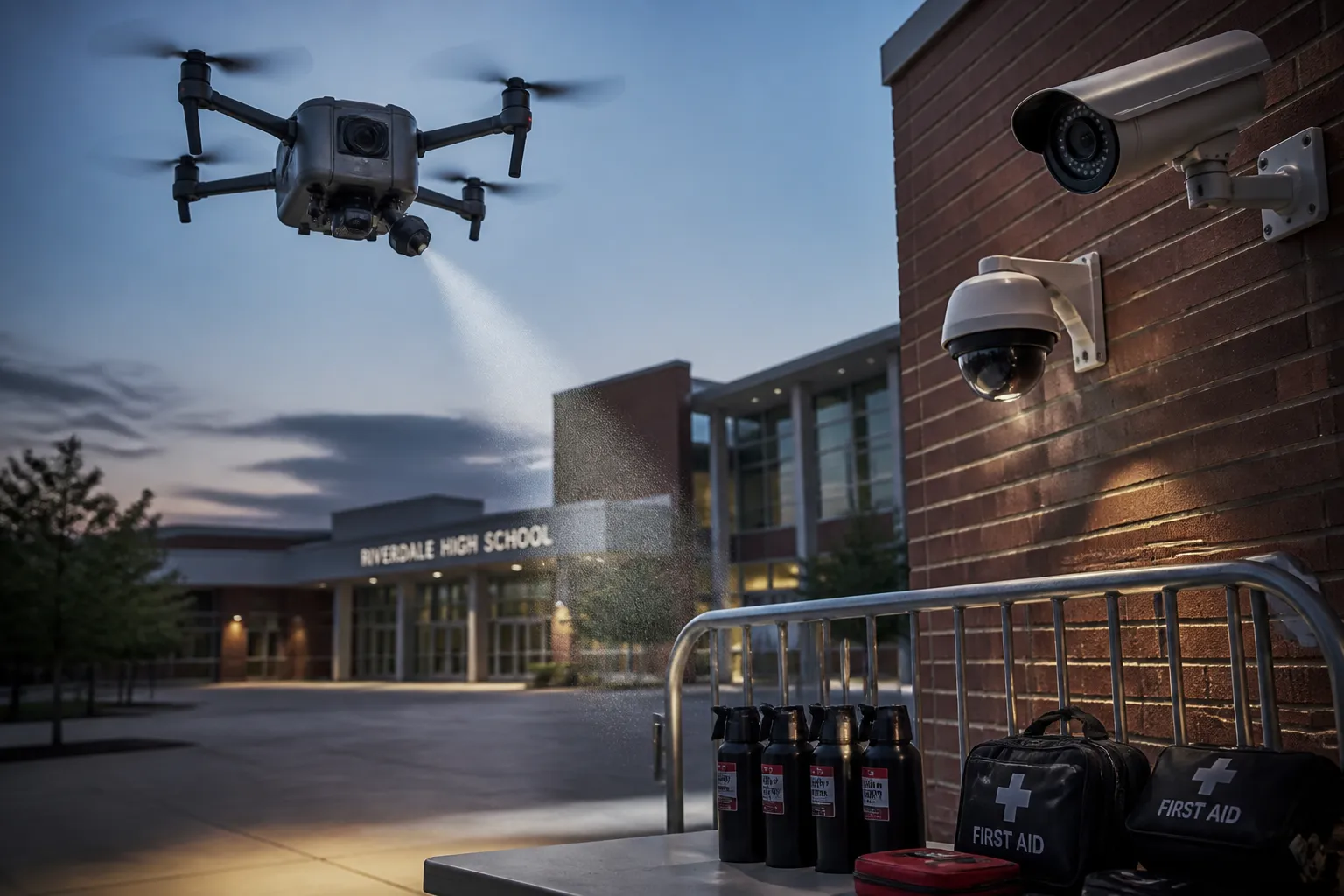
In a move that has sparked intense debate, several U.S. schools are installing pepper‑spraying drones as a new counter‑measures against active shooter incidents. The system, supplied by Austin‑based Campus Guardian Angel, is slated for deployment at a minimum of nine schools across Florida, Georgia, and Colorado during the 2026‑2027 academic year.
Campus Guardian Angel markets itself as a response‑capability firm that designs and manufactures both aircraft and firmware. According to the company’s website, the drones are launched automatically after a school reports an attack and after a response team confirms the threat is credible. Operators can control the aircraft from thousands of miles away, and a two‑way speakerphone allows the company’s operations center to communicate directly with teachers, staff, and law‑enforcement officers.
The drones carry a pepper‑gel launcher capable of firing pepper balls at a shooter and can also deliver kinetic‑energy strikes to a confirmed attacker. The company says the goal is to “greatly degrade or incapacitate” the shooter while a wave of three or four drones keeps the suspect occupied until police arrive.
The Georgia schools slated to pilot the program include Coffee County High School in Douglas, Gainesville High School in Gainesville, River Ridge High School in Woodstock, and Statesboro High School in Statesboro. The state legislature allocated $550,000 in its 2026 budget to fund the initiative.
In Florida, Deltona High School in Volusia County will receive 39 drones for the upcoming school year. Other Florida schools expected to launch the program are Amos P. Godby High School in Leon County and Boyd H. Anderson High School in Broward County.
John Adams Academy in Douglas County, Colorado, is also preparing to introduce the technology. Academy head Sarah Kiesewetter told Denver7 that the school may be the first in Colorado to consider drone technology.
The concept was inspired by the use of small drones on the battlefields of Ukraine after Russia’s invasion in February 2022. Campus Guardian Angel co‑founder Bill King, a former senior enlisted leader for Navy SEAL teams, said in a Washington Post interview that the drones “can’t be escaped” once deployed.
Tactical operations director Khristof Oborski, a former Austin Police Department SWAT unit leader, explained to Barron’s that King observed the effectiveness of drones in Ukraine and began thinking about how to apply the technology to the U.S. school‑shooting problem.
Critics argue that the drones are a reactive measure that does not address prevention. Tony Montalto, whose 14‑year‑old daughter was killed in the 2018 Parkland shooting, told WPTV that the drones “are not patrolling – they just pop up when needed” and that the focus should remain on prevention.
The Washington Post’s September data shows that more than 398,000 students have experienced gun violence at school since the 1999 Columbine high‑school shooting. The new drone program is therefore being implemented amid a broader national debate over school safety and gun violence.
The drones can remain airborne for about eight minutes on a single battery charge and operate at 900 MHz. They are designed to fly through windows that are not coated with ballistic film, using a front lance to break through. The drones also carry sirens and can drop air poppers that create a loud bang.
The Georgia legislature’s funding and the schools’ procurement of the drones represent the first large‑scale deployment of pepper‑spraying drones in the United States. The program’s effectiveness and impact on school safety remain to be seen, as no real‑world activations have yet occurred.
The initiative is part of a broader trend of schools experimenting with technology‑based security solutions, including autonomous drones, to respond to active shooter incidents. The federal government has not yet issued guidance on the use of such drones in schools.
The current status is that the nine schools are preparing to install the drones for the 2026‑2027 school year. No official statement has been released regarding the timeline for the first deployment or the criteria that will trigger a drone launch. The program’s success will likely be evaluated by school administrators, law‑enforcement partners, and state officials as incidents occur.
The debate continues over whether technology such as pepper‑spraying drones can meaningfully reduce casualties in school shootings, or whether resources should be directed toward prevention and mental‑health initiatives.
Campus Guardian Angel markets itself as a response‑capability firm that designs and manufactures both aircraft and firmware. According to the company’s website, the drones are launched automatically after a school reports an attack and after a response team confirms the threat is credible. Operators can control the aircraft from thousands of miles away, and a two‑way speakerphone allows the company’s operations center to communicate directly with teachers, staff, and law‑enforcement officers.
The drones carry a pepper‑gel launcher capable of firing pepper balls at a shooter and can also deliver kinetic‑energy strikes to a confirmed attacker. The company says the goal is to “greatly degrade or incapacitate” the shooter while a wave of three or four drones keeps the suspect occupied until police arrive.
The Georgia schools slated to pilot the program include Coffee County High School in Douglas, Gainesville High School in Gainesville, River Ridge High School in Woodstock, and Statesboro High School in Statesboro. The state legislature allocated $550,000 in its 2026 budget to fund the initiative.
In Florida, Deltona High School in Volusia County will receive 39 drones for the upcoming school year. Other Florida schools expected to launch the program are Amos P. Godby High School in Leon County and Boyd H. Anderson High School in Broward County.
John Adams Academy in Douglas County, Colorado, is also preparing to introduce the technology. Academy head Sarah Kiesewetter told Denver7 that the school may be the first in Colorado to consider drone technology.
The concept was inspired by the use of small drones on the battlefields of Ukraine after Russia’s invasion in February 2022. Campus Guardian Angel co‑founder Bill King, a former senior enlisted leader for Navy SEAL teams, said in a Washington Post interview that the drones “can’t be escaped” once deployed.
Tactical operations director Khristof Oborski, a former Austin Police Department SWAT unit leader, explained to Barron’s that King observed the effectiveness of drones in Ukraine and began thinking about how to apply the technology to the U.S. school‑shooting problem.
Critics argue that the drones are a reactive measure that does not address prevention. Tony Montalto, whose 14‑year‑old daughter was killed in the 2018 Parkland shooting, told WPTV that the drones “are not patrolling – they just pop up when needed” and that the focus should remain on prevention.
The Washington Post’s September data shows that more than 398,000 students have experienced gun violence at school since the 1999 Columbine high‑school shooting. The new drone program is therefore being implemented amid a broader national debate over school safety and gun violence.
The drones can remain airborne for about eight minutes on a single battery charge and operate at 900 MHz. They are designed to fly through windows that are not coated with ballistic film, using a front lance to break through. The drones also carry sirens and can drop air poppers that create a loud bang.
The Georgia legislature’s funding and the schools’ procurement of the drones represent the first large‑scale deployment of pepper‑spraying drones in the United States. The program’s effectiveness and impact on school safety remain to be seen, as no real‑world activations have yet occurred.
The initiative is part of a broader trend of schools experimenting with technology‑based security solutions, including autonomous drones, to respond to active shooter incidents. The federal government has not yet issued guidance on the use of such drones in schools.
The current status is that the nine schools are preparing to install the drones for the 2026‑2027 school year. No official statement has been released regarding the timeline for the first deployment or the criteria that will trigger a drone launch. The program’s success will likely be evaluated by school administrators, law‑enforcement partners, and state officials as incidents occur.
The debate continues over whether technology such as pepper‑spraying drones can meaningfully reduce casualties in school shootings, or whether resources should be directed toward prevention and mental‑health initiatives.