Blab News
Total Solar Eclipse Sweeps Greenland, Iceland, and Spain on August 12, 2026
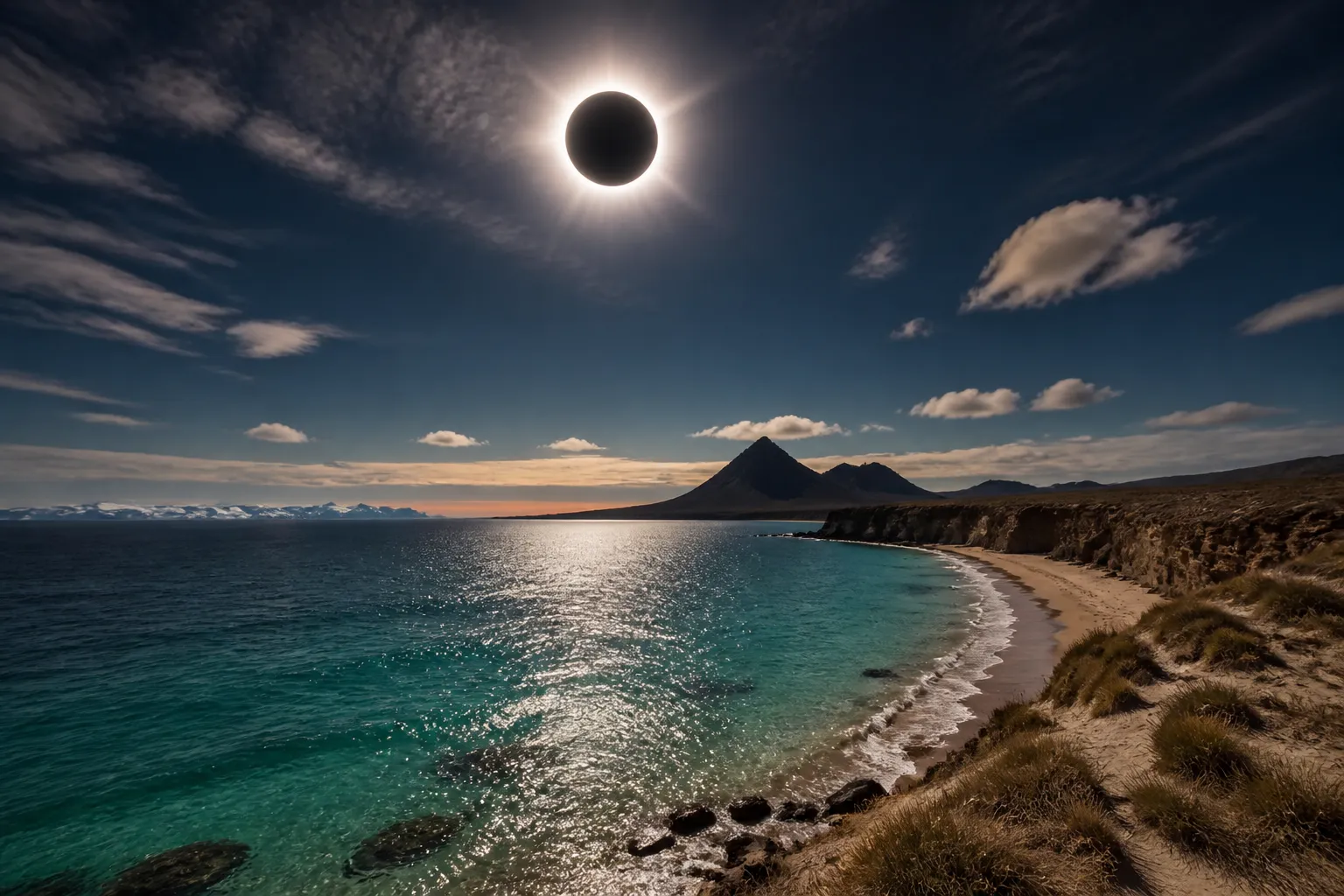
A total solar eclipse crossed the northern hemisphere on Wednesday, August 12, 2026, moving from east to west across the Arctic Ocean, Greenland, Iceland, and northern Spain. The event, which began in the Arctic and ended over the Atlantic coast of Spain, was the first total eclipse visible in mainland Europe since 1999 and the first in Iceland since 1954.
The eclipse’s path of totality covered a narrow strip about 200 km wide. The greatest duration of totality—2 minutes and 18.2 seconds—occurred just 45 km off the western coast of Iceland, near 65°30′ N, 25°25′ W. In Greenland, the eclipse passed over the eastern edge of the island, while in Spain it crossed the northern coast from the Atlantic to the Mediterranean, reaching cities such as A Coruña, Valencia, Zaragoza, Palma and Bilbao. Madrid and Barcelona lay just outside the path of totality.
NASA’s eclipse calculations show a magnitude of 1.0386, meaning the Moon’s apparent diameter exceeded the Sun’s by about 3.9 percent. The eclipse occurred roughly 2.2 days after the Moon’s perigee on August 10, giving the Moon a slightly larger apparent size. The partial eclipse, visible from a wide surrounding region, covered more than 90 percent of the Sun’s disk in Ireland, Great Britain, Portugal, France, Italy, the Balkans, North Africa and parts of Europe, West Africa and northern North America.
The event was the first total solar eclipse to be seen from Greenland in more than a century. Greenland, an autonomous territory of Denmark with a population of about 56,000, is largely uninhabited except along the southwest coast. The eclipse drew attention from local communities and visitors, many of whom gathered in prime viewing locations. In Iceland, a country with a population of roughly 395,000, the eclipse attracted crowds in Reykjavík and surrounding towns.
The next total solar eclipse will occur on August 2, 2027, when the shadow passes over southern Spain, North Africa, Saudi Arabia and Yemen. The United States will not see another total eclipse until August 22, 2044, when the path will be limited to North Dakota and Montana.
Safety advice from NASA and local authorities emphasized the use of certified eclipse glasses or handheld solar viewers. Direct observation of the Sun without proper protection can cause permanent eye damage. Viewers in the affected regions were urged to follow local guidelines and to avoid using improvised filters.
The eclipse’s path also crossed the Arctic Ocean and parts of northern Russia, the Atlantic Ocean, and a small corner of Portugal. In the Atlantic, the shadow passed over the Azores and the Canary Islands, where partial eclipse conditions were observed.
The event was covered by international media and live streams, including a special broadcast by CNN. Scientists and amateur astronomers used the opportunity to study the Sun’s corona and to test instrumentation. The National Solar Observatory and the National Science Foundation released data on the eclipse’s timing and magnitude.
The eclipse’s significance extends beyond the scientific community. It marked a rare celestial event for European audiences, with the last total eclipse visible from mainland Europe occurring in 1999. In Spain, the last total eclipse was observed on August 30, 1905, and the 2026 event was the first in the country’s mainland since then.
As the eclipse concluded, observers reported clear skies and a dramatic transition to darkness. The event will be remembered as a rare opportunity for both scientific observation and public enjoyment of a natural phenomenon.
The next major eclipse for the United States will be in 2044, and for Europe, the 2027 eclipse will again bring totality to parts of Spain and North Africa. The scientific community will continue to monitor the Sun and the Moon’s orbital dynamics in preparation for these future events.
The eclipse’s path of totality covered a narrow strip about 200 km wide. The greatest duration of totality—2 minutes and 18.2 seconds—occurred just 45 km off the western coast of Iceland, near 65°30′ N, 25°25′ W. In Greenland, the eclipse passed over the eastern edge of the island, while in Spain it crossed the northern coast from the Atlantic to the Mediterranean, reaching cities such as A Coruña, Valencia, Zaragoza, Palma and Bilbao. Madrid and Barcelona lay just outside the path of totality.
NASA’s eclipse calculations show a magnitude of 1.0386, meaning the Moon’s apparent diameter exceeded the Sun’s by about 3.9 percent. The eclipse occurred roughly 2.2 days after the Moon’s perigee on August 10, giving the Moon a slightly larger apparent size. The partial eclipse, visible from a wide surrounding region, covered more than 90 percent of the Sun’s disk in Ireland, Great Britain, Portugal, France, Italy, the Balkans, North Africa and parts of Europe, West Africa and northern North America.
The event was the first total solar eclipse to be seen from Greenland in more than a century. Greenland, an autonomous territory of Denmark with a population of about 56,000, is largely uninhabited except along the southwest coast. The eclipse drew attention from local communities and visitors, many of whom gathered in prime viewing locations. In Iceland, a country with a population of roughly 395,000, the eclipse attracted crowds in Reykjavík and surrounding towns.
The next total solar eclipse will occur on August 2, 2027, when the shadow passes over southern Spain, North Africa, Saudi Arabia and Yemen. The United States will not see another total eclipse until August 22, 2044, when the path will be limited to North Dakota and Montana.
Safety advice from NASA and local authorities emphasized the use of certified eclipse glasses or handheld solar viewers. Direct observation of the Sun without proper protection can cause permanent eye damage. Viewers in the affected regions were urged to follow local guidelines and to avoid using improvised filters.
The eclipse’s path also crossed the Arctic Ocean and parts of northern Russia, the Atlantic Ocean, and a small corner of Portugal. In the Atlantic, the shadow passed over the Azores and the Canary Islands, where partial eclipse conditions were observed.
The event was covered by international media and live streams, including a special broadcast by CNN. Scientists and amateur astronomers used the opportunity to study the Sun’s corona and to test instrumentation. The National Solar Observatory and the National Science Foundation released data on the eclipse’s timing and magnitude.
The eclipse’s significance extends beyond the scientific community. It marked a rare celestial event for European audiences, with the last total eclipse visible from mainland Europe occurring in 1999. In Spain, the last total eclipse was observed on August 30, 1905, and the 2026 event was the first in the country’s mainland since then.
As the eclipse concluded, observers reported clear skies and a dramatic transition to darkness. The event will be remembered as a rare opportunity for both scientific observation and public enjoyment of a natural phenomenon.
The next major eclipse for the United States will be in 2044, and for Europe, the 2027 eclipse will again bring totality to parts of Spain and North Africa. The scientific community will continue to monitor the Sun and the Moon’s orbital dynamics in preparation for these future events.