Blab News
Chinas Sodium-Ion Battery Divide: CATL Targets Vehicles, BYD Drives Grid Storage
When a 45‑kWh sodium‑ion pack slipped into a production car, the electric‑vehicle world paused. In June 2026, China’s battery giant CATL, together with Changan Automobile, unveiled the first passenger‑vehicle line that relies on sodium‑ion chemistry. The new pack is engineered to keep 90 % of its usable capacity even at –40 °C, and it promises fast charging and a long driving range.
The launch marked a milestone that followed CATL’s earlier introduction of a sodium‑ion pack for light commercial vehicles. The June 2026 model is the first time the technology has entered a mainstream passenger‑car production line, signalling that the company is willing to take the leap from niche to mass‑market applications.
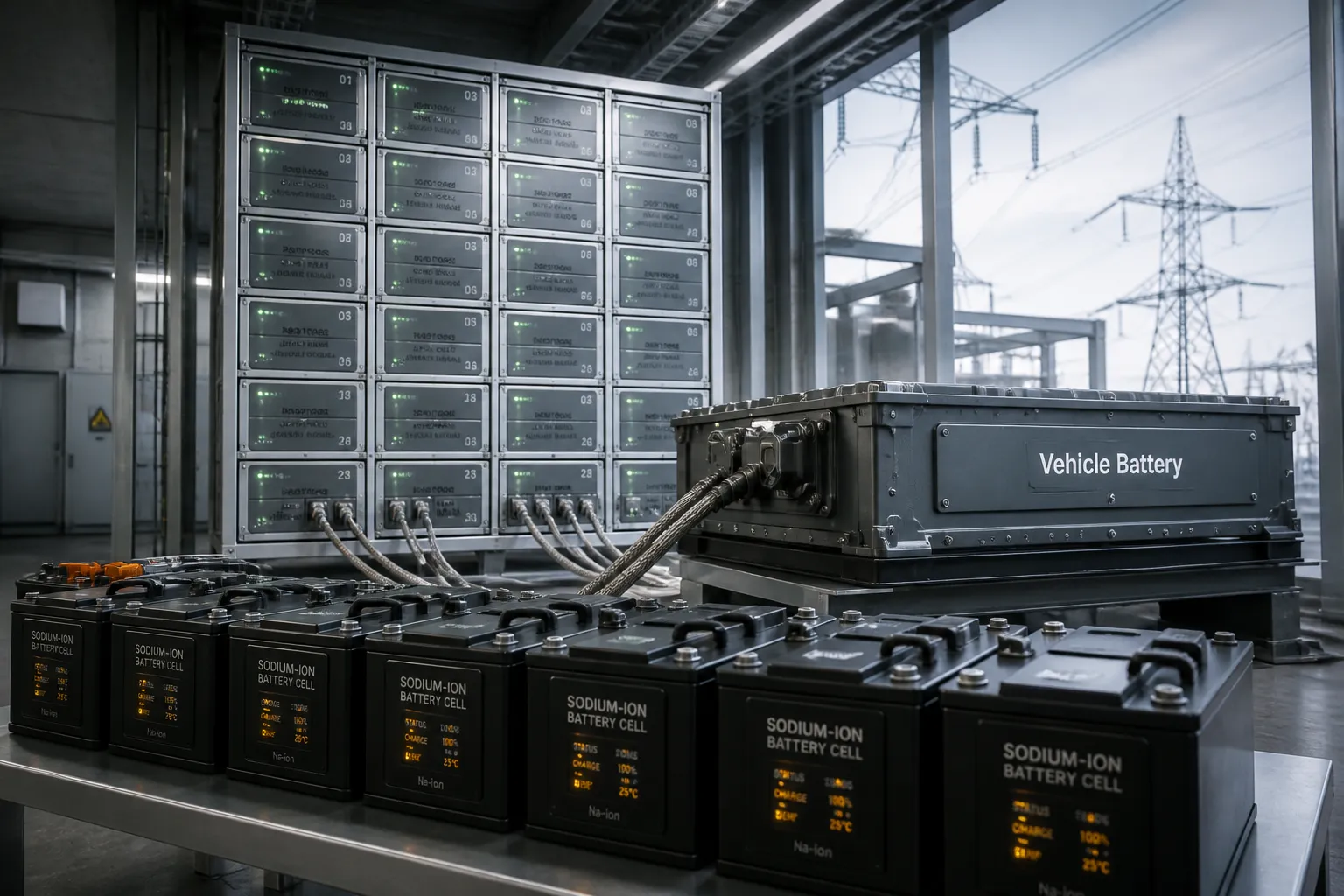
Across the aisle, BYD has charted a different path. The company announced that its third‑generation polyanion platform would focus on stationary energy‑storage systems, targeting a manufacturing cost of $0.04 per watt‑hour by 2027. Its flagship product, the MC Cube‑SIB ESS container, is described as the world’s first high‑performance sodium‑ion battery for grid storage.
The MC Cube‑SIB uses BYD’s Blade‑packing architecture, which integrates the cell and module into a single, compact unit. Laboratory tests of the R&D cells show a 200 Ah capacity and more than 10,000 charge‑discharge cycles. Under standard grid‑cycling conditions, the 10,000‑cycle threshold translates to an estimated operational life of 33 years.
A June 8 industry depth report from Minmetals Securities compared BYD’s polyanion chemistry with a layered‑oxide alternative. The polyanion cells have a maximum thermal‑runaway temperature of 273.32 °C, compared with 484.51 °C for the layered‑oxide cells. Total volumetric gas evolution is 93.1 L for the polyanion cells versus 123.25 L for the layered‑oxide cells. The report notes that the polyanion chemistry is targeted for 200 Ah long‑form cells, whereas the layered‑oxide chemistry is aimed at lower‑capacity, higher Wh/kg cells suitable for utility‑scale grid power.
BYD’s polyanion platform tackles two key hurdles that have limited sodium‑ion batteries in electric‑vehicle applications: sodium precipitation and heat generation. The platform achieves 10,000 cycles—roughly double the 2,000–3,000 cycles typical of lithium‑iron‑phosphate batteries used in EVs. The lower maximum temperature and reduced gas evolution make the polyanion chemistry safer and better suited for dense, indoor commercial energy‑storage installations.
Cost parity with lithium‑iron‑phosphate lines is projected for 2027, according to the source. The delay is largely attributed to fragmented hard‑carbon anode supply chains and the absence of a standardized processing pathway. Despite this, the global sodium‑ion battery market is expected to grow from $1.8 billion in 2025 to $12.5 billion by 2035, with the grid‑storage segment leading at a 48 % share by 2035. BYD’s early entry into grid storage gives it a structural advantage as the market expands.
Patent activity reflects the companies’ divergent focuses. CATL holds 85 % of the patent volume in the sodium‑ion field and targets electric‑vehicle applications through robust interface designs. BYD, by contrast, concentrates on cost‑optimized materials for grid deployment. The two firms now operate in distinct niches rather than competing directly within the sodium‑ion market.
At present, the sodium‑ion battery sector is split between vehicle and grid applications. CATL and Changan’s 45 kWh pack has entered the passenger‑vehicle market, while BYD’s MC Cube‑SIB ESS container has begun pilot deployments in utility‑scale storage projects. Upcoming developments will include the scaling of BYD’s polyanion production to meet the $0.04 per watt‑hour target, the expansion of CATL’s vehicle‑grade sodium‑ion line, and the continued maturation of hard‑carbon anode supply chains. The industry will monitor how cost parity is achieved and how the market share projections unfold.
The launch marked a milestone that followed CATL’s earlier introduction of a sodium‑ion pack for light commercial vehicles. The June 2026 model is the first time the technology has entered a mainstream passenger‑car production line, signalling that the company is willing to take the leap from niche to mass‑market applications.
Across the aisle, BYD has charted a different path. The company announced that its third‑generation polyanion platform would focus on stationary energy‑storage systems, targeting a manufacturing cost of $0.04 per watt‑hour by 2027. Its flagship product, the MC Cube‑SIB ESS container, is described as the world’s first high‑performance sodium‑ion battery for grid storage.
The MC Cube‑SIB uses BYD’s Blade‑packing architecture, which integrates the cell and module into a single, compact unit. Laboratory tests of the R&D cells show a 200 Ah capacity and more than 10,000 charge‑discharge cycles. Under standard grid‑cycling conditions, the 10,000‑cycle threshold translates to an estimated operational life of 33 years.
A June 8 industry depth report from Minmetals Securities compared BYD’s polyanion chemistry with a layered‑oxide alternative. The polyanion cells have a maximum thermal‑runaway temperature of 273.32 °C, compared with 484.51 °C for the layered‑oxide cells. Total volumetric gas evolution is 93.1 L for the polyanion cells versus 123.25 L for the layered‑oxide cells. The report notes that the polyanion chemistry is targeted for 200 Ah long‑form cells, whereas the layered‑oxide chemistry is aimed at lower‑capacity, higher Wh/kg cells suitable for utility‑scale grid power.
BYD’s polyanion platform tackles two key hurdles that have limited sodium‑ion batteries in electric‑vehicle applications: sodium precipitation and heat generation. The platform achieves 10,000 cycles—roughly double the 2,000–3,000 cycles typical of lithium‑iron‑phosphate batteries used in EVs. The lower maximum temperature and reduced gas evolution make the polyanion chemistry safer and better suited for dense, indoor commercial energy‑storage installations.
Cost parity with lithium‑iron‑phosphate lines is projected for 2027, according to the source. The delay is largely attributed to fragmented hard‑carbon anode supply chains and the absence of a standardized processing pathway. Despite this, the global sodium‑ion battery market is expected to grow from $1.8 billion in 2025 to $12.5 billion by 2035, with the grid‑storage segment leading at a 48 % share by 2035. BYD’s early entry into grid storage gives it a structural advantage as the market expands.
Patent activity reflects the companies’ divergent focuses. CATL holds 85 % of the patent volume in the sodium‑ion field and targets electric‑vehicle applications through robust interface designs. BYD, by contrast, concentrates on cost‑optimized materials for grid deployment. The two firms now operate in distinct niches rather than competing directly within the sodium‑ion market.
At present, the sodium‑ion battery sector is split between vehicle and grid applications. CATL and Changan’s 45 kWh pack has entered the passenger‑vehicle market, while BYD’s MC Cube‑SIB ESS container has begun pilot deployments in utility‑scale storage projects. Upcoming developments will include the scaling of BYD’s polyanion production to meet the $0.04 per watt‑hour target, the expansion of CATL’s vehicle‑grade sodium‑ion line, and the continued maturation of hard‑carbon anode supply chains. The industry will monitor how cost parity is achieved and how the market share projections unfold.