Blab News
Russias Shadow Fleet: How Permissive Registries Let Sanctions Slip Through
The world’s largest oil exporters have long relied on a network of shell vessels that can be re‑flagged in a heartbeat. In the first year after Russia’s full‑scale invasion of Ukraine, that network exploded into a shadow fleet of roughly 600 ships—400 crude carriers and 200 product tankers—moving oil outside Western maritime jurisdictions. By December 2023, energy‑analytics firm Vortexa counted 1,089 tankers operating on the Russian oil market, despite a barrage of Western sanctions.
The fleet’s rapid growth exposes a structural weakness in the global shipping system. The same loopholes that North Korea exploited in the 2010s—name laundering, flags of convenience, and fraudulent registries—remain active. North Korea’s smaller shadow fleet, limited to about 600 vessels over a decade, leaned on permissive registries in Sierra Leone, Panama, and Cambodia, and coordinated a 2017 fraud through a Fiji registry. RUSI’s database shows that more than 90 vessels claimed Fijian registration that year, 20 of which were linked to Pyongyang.
Russia, in contrast, had been a mainstream participant in international trade for decades. After the invasion, it did not build a new network from scratch; it leveraged existing commercial pathways. Windward’s analysis lists registries used by Russian vessels in Gabon, the Cook Islands, Barbados, Palau, Gambia, Sierra Leone, San Marino, Guinea‑Bissau, Cameroon, and Oman. These registries are typically run by private firms contracted by the flag states, offering fast registration and minimal due‑diligence requirements.
The problem is that sanctions target individual vessels and owners but rarely penalize the institutions that enable them. Registries earn substantial revenue from registration fees, tonnage charges, and compliance costs. Because vessels can shift between registries, operators that impose stricter controls risk losing business to more lenient competitors. The incentive structure therefore encourages registries to prioritize revenue over enforcement.
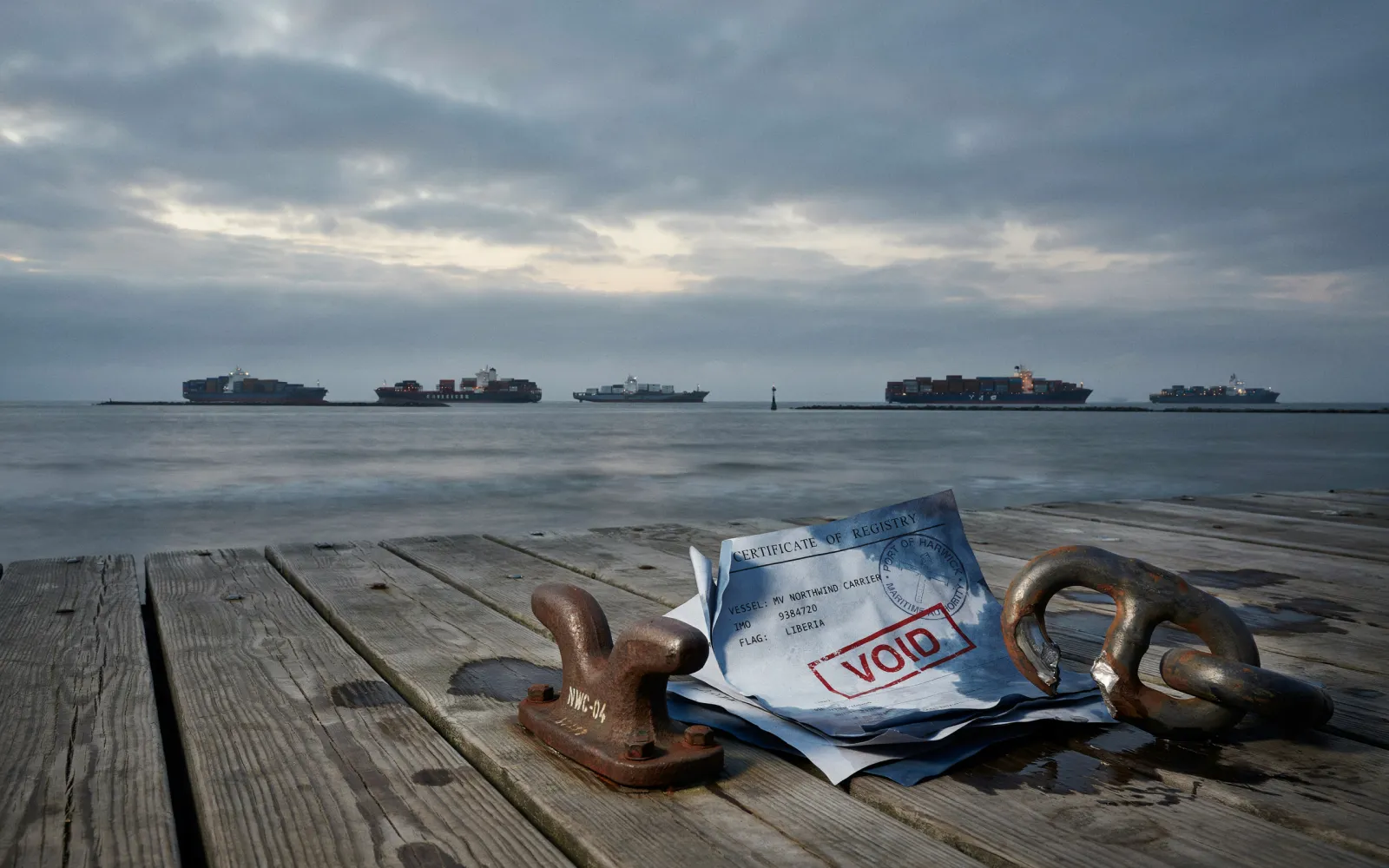
In January 2026, Windward identified 18 fraudulent registries recognized by the International Maritime Organization. Ninety‑one percent of vessels claiming registration with those registries were already sanctioned. The concentration of sanctioned vessels in fraudulent registries suggests that they serve as a fallback for ships excluded from legitimate registries.
Both North Korea and Russia use the same tactics, but the scale differs dramatically. North Korea’s fleet never exceeded 600 vessels over a decade, whereas Russia’s shadow fleet reached 400–650 vessels by October 2023—nearly half the size of North Korea’s entire commercial fleet, according to the UN Trade and Development Data Hub.
The EU’s 20th sanctions package, adopted on 23 April 2026, and parallel U.S. and U.K. measures have expanded the list of sanctioned Russian oil producers and vessels. Yet the underlying registry loopholes remain. A potential solution is to extend sanctions to registries that continue to flag shadow vessels after designation. Because many registries conduct transactions in U.S. dollars and rely on U.S.‑linked service providers, sanctions could cut off payment channels, insurers, and banks, raising the cost of registration for both sanctioned and legitimate customers.
Without structural changes to registry incentives and enforcement, shadow fleets will continue to grow. The current approach—sanctioning individual vessels—has proven reactive and limited. A more proactive strategy that targets the institutions enabling sanctions evasion could make it harder for state actors to sustain illicit maritime trade.
The shadow fleet’s persistence underscores the need for coordinated international action. While the EU and U.S. have tightened sanctions on Russian oil producers, the maritime sector’s regulatory gaps allow Russia to preserve a critical revenue stream and finance its war effort. Closing these gaps will require a shift from punitive measures against vessels alone to a comprehensive framework that holds registries and service providers accountable.
The fleet’s rapid growth exposes a structural weakness in the global shipping system. The same loopholes that North Korea exploited in the 2010s—name laundering, flags of convenience, and fraudulent registries—remain active. North Korea’s smaller shadow fleet, limited to about 600 vessels over a decade, leaned on permissive registries in Sierra Leone, Panama, and Cambodia, and coordinated a 2017 fraud through a Fiji registry. RUSI’s database shows that more than 90 vessels claimed Fijian registration that year, 20 of which were linked to Pyongyang.
Russia, in contrast, had been a mainstream participant in international trade for decades. After the invasion, it did not build a new network from scratch; it leveraged existing commercial pathways. Windward’s analysis lists registries used by Russian vessels in Gabon, the Cook Islands, Barbados, Palau, Gambia, Sierra Leone, San Marino, Guinea‑Bissau, Cameroon, and Oman. These registries are typically run by private firms contracted by the flag states, offering fast registration and minimal due‑diligence requirements.
The problem is that sanctions target individual vessels and owners but rarely penalize the institutions that enable them. Registries earn substantial revenue from registration fees, tonnage charges, and compliance costs. Because vessels can shift between registries, operators that impose stricter controls risk losing business to more lenient competitors. The incentive structure therefore encourages registries to prioritize revenue over enforcement.
In January 2026, Windward identified 18 fraudulent registries recognized by the International Maritime Organization. Ninety‑one percent of vessels claiming registration with those registries were already sanctioned. The concentration of sanctioned vessels in fraudulent registries suggests that they serve as a fallback for ships excluded from legitimate registries.
Both North Korea and Russia use the same tactics, but the scale differs dramatically. North Korea’s fleet never exceeded 600 vessels over a decade, whereas Russia’s shadow fleet reached 400–650 vessels by October 2023—nearly half the size of North Korea’s entire commercial fleet, according to the UN Trade and Development Data Hub.
The EU’s 20th sanctions package, adopted on 23 April 2026, and parallel U.S. and U.K. measures have expanded the list of sanctioned Russian oil producers and vessels. Yet the underlying registry loopholes remain. A potential solution is to extend sanctions to registries that continue to flag shadow vessels after designation. Because many registries conduct transactions in U.S. dollars and rely on U.S.‑linked service providers, sanctions could cut off payment channels, insurers, and banks, raising the cost of registration for both sanctioned and legitimate customers.
Without structural changes to registry incentives and enforcement, shadow fleets will continue to grow. The current approach—sanctioning individual vessels—has proven reactive and limited. A more proactive strategy that targets the institutions enabling sanctions evasion could make it harder for state actors to sustain illicit maritime trade.
The shadow fleet’s persistence underscores the need for coordinated international action. While the EU and U.S. have tightened sanctions on Russian oil producers, the maritime sector’s regulatory gaps allow Russia to preserve a critical revenue stream and finance its war effort. Closing these gaps will require a shift from punitive measures against vessels alone to a comprehensive framework that holds registries and service providers accountable.