Blab News
Thousands Protest in Geneva Ahead of G7 Summit as Swiss and French Authorities Tighten Security
On Sunday, June 14, 2026, Geneva’s lakeside park transformed into a stage for dissent as more than 10,000 demonstrators streamed into the city to oppose the Group of Seven (G7) summit that would begin the next day in Evian‑les‑Bains, France. The march, organized by the “No‑G7” coalition, drew a diverse coalition of over 60 associations, unions and activist groups, including environmentalists, feminists, supporters of Palestinian rights, defenders of independent media and anti‑imperialist organisations.
The route cut across Geneva’s main thoroughfares, punctuated by a boat on Lake Geneva bearing a sail that read “No G7.” A small contingent of about fifteen youths in black hoodies and masks stood behind an anti‑Trump banner, while other protesters carried signs proclaiming, “Antisemitic never; anti‑Zionist always.” The broad cross‑section of civil society that gathered reflected the coalition’s platform of opposing what it calls “fascism and imperialism.”
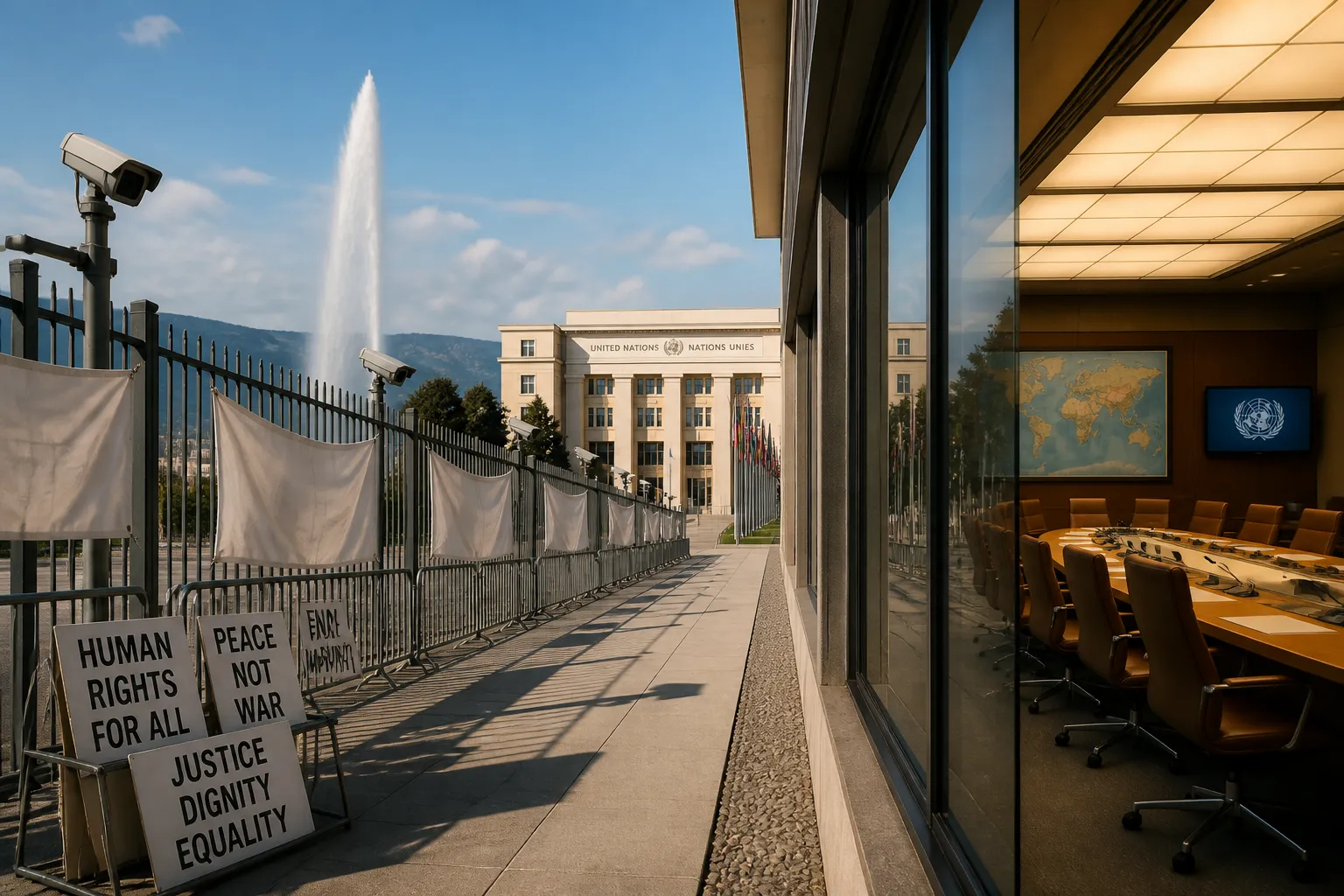
In preparation for the summit, Swiss police and French authorities deployed thousands of officers in the days leading up to the event. They closed 25 of the 35 road crossings between Geneva and the French border, leaving only seven open, and erected barricades along major routes. Shops and businesses in the city’s centre boarded up their windows in anticipation of unrest, recalling the damage that occurred during the 2003 Evian G8 summit.
The G7 summit, scheduled for June 15‑17, will be hosted by France, which holds the rotating presidency for the group. Leaders from Canada, France, Germany, Italy, Japan, the United Kingdom, the United States, and the European Union will convene to discuss a range of issues, including the Middle East, Ukraine, global economic imbalances and climate policy. President Donald Trump, who is returning to the summit for his second visit since re‑election, is expected to meet with leaders from the Middle East and Ukraine.
According to French police, authorities have pledged financial support for businesses that may suffer losses due to the protest. The Swiss cantonal government has also taken measures to protect the city’s infrastructure and to ensure that emergency services remain operational.
The “No‑G7” coalition has been active in Geneva for several days, holding rallies and preparing permits for the Sunday march. Its members argue that the G7 agenda is dominated by the interests of wealthy nations and that the summit’s focus on trade, security and climate change does not adequately address the needs of poorer countries.
The protest in Geneva is part of a broader pattern of demonstrations that have taken place across Europe in the weeks leading up to the summit. In France, police officers have been checking cars at the border between Geneva and the town of Gaillard, and traffic jams have been reported on both sides of the border.
The G7’s informal nature means it has no permanent secretariat, but its leaders wield significant influence over global economic policy. The 2026 summit will be the first time that Evian‑les‑Bains hosts a G7 or G8 leaders’ meeting twice; the town previously hosted the 2003 G8 summit.
Swiss and French authorities have warned that any unauthorized gatherings could be dispersed by force, and they have restricted access to certain areas of the city. The police have also increased patrols along the lakeside promenade and in the city centre.
The protest in Geneva is expected to continue as the summit begins. Authorities have indicated that they will maintain a heightened security presence throughout the three‑day event. The “No‑G7” coalition has not announced any plans for further demonstrations beyond the Sunday march.
The G7 summit is expected to conclude on June 17, after which the leaders will return to their respective countries. The outcome of the summit will likely influence international policy on the Middle East, Ukraine, climate change and global economic governance.
The protests in Geneva highlight the growing discontent among civil society groups in Europe over the perceived lack of inclusivity in the G7’s agenda. While the Swiss and French authorities have taken steps to protect businesses and infrastructure, the city’s residents and businesses remain on alert as the summit proceeds.
The situation remains fluid, and further developments will be reported as the summit continues and as the authorities respond to any incidents that may arise.
The route cut across Geneva’s main thoroughfares, punctuated by a boat on Lake Geneva bearing a sail that read “No G7.” A small contingent of about fifteen youths in black hoodies and masks stood behind an anti‑Trump banner, while other protesters carried signs proclaiming, “Antisemitic never; anti‑Zionist always.” The broad cross‑section of civil society that gathered reflected the coalition’s platform of opposing what it calls “fascism and imperialism.”
In preparation for the summit, Swiss police and French authorities deployed thousands of officers in the days leading up to the event. They closed 25 of the 35 road crossings between Geneva and the French border, leaving only seven open, and erected barricades along major routes. Shops and businesses in the city’s centre boarded up their windows in anticipation of unrest, recalling the damage that occurred during the 2003 Evian G8 summit.
The G7 summit, scheduled for June 15‑17, will be hosted by France, which holds the rotating presidency for the group. Leaders from Canada, France, Germany, Italy, Japan, the United Kingdom, the United States, and the European Union will convene to discuss a range of issues, including the Middle East, Ukraine, global economic imbalances and climate policy. President Donald Trump, who is returning to the summit for his second visit since re‑election, is expected to meet with leaders from the Middle East and Ukraine.
According to French police, authorities have pledged financial support for businesses that may suffer losses due to the protest. The Swiss cantonal government has also taken measures to protect the city’s infrastructure and to ensure that emergency services remain operational.
The “No‑G7” coalition has been active in Geneva for several days, holding rallies and preparing permits for the Sunday march. Its members argue that the G7 agenda is dominated by the interests of wealthy nations and that the summit’s focus on trade, security and climate change does not adequately address the needs of poorer countries.
The protest in Geneva is part of a broader pattern of demonstrations that have taken place across Europe in the weeks leading up to the summit. In France, police officers have been checking cars at the border between Geneva and the town of Gaillard, and traffic jams have been reported on both sides of the border.
The G7’s informal nature means it has no permanent secretariat, but its leaders wield significant influence over global economic policy. The 2026 summit will be the first time that Evian‑les‑Bains hosts a G7 or G8 leaders’ meeting twice; the town previously hosted the 2003 G8 summit.
Swiss and French authorities have warned that any unauthorized gatherings could be dispersed by force, and they have restricted access to certain areas of the city. The police have also increased patrols along the lakeside promenade and in the city centre.
The protest in Geneva is expected to continue as the summit begins. Authorities have indicated that they will maintain a heightened security presence throughout the three‑day event. The “No‑G7” coalition has not announced any plans for further demonstrations beyond the Sunday march.
The G7 summit is expected to conclude on June 17, after which the leaders will return to their respective countries. The outcome of the summit will likely influence international policy on the Middle East, Ukraine, climate change and global economic governance.
The protests in Geneva highlight the growing discontent among civil society groups in Europe over the perceived lack of inclusivity in the G7’s agenda. While the Swiss and French authorities have taken steps to protect businesses and infrastructure, the city’s residents and businesses remain on alert as the summit proceeds.
The situation remains fluid, and further developments will be reported as the summit continues and as the authorities respond to any incidents that may arise.